
A franchise can reduce some of the uncertainty of starting a business, but it does not remove business risk. The best decisions come from comparing facts, testing assumptions and getting independent advice.
Why rooftop solar dealership searches are rising in 2026
An August 2026 government update reported more than 50.06 lakh beneficiary households under PM Surya Ghar, 14.8 GW commissioned and a peak pace of about 16,328 household installations per day in July. That scale is creating searches for solar dealership, distributorship, installation partner, vendor registration and subsidy business. Demand is real, but these phrases describe different roles and liabilities.
Dealer, lead partner and empanelled vendor are not the same
A dealer may sell modules, inverters and balance-of-system items. A lead or channel partner may find customers and pass qualified projects to an EPC company. An installation or EPC partner surveys, designs, procures, installs, commissions and supports the system. A vendor serving subsidised residential projects must follow the National Portal and applicable DISCOM process. Get the exact role in writing before paying any brand.
What is included in the investment? What support continues after launch? Which assumptions drive the payback estimate?
PM Surya Ghar is a government scheme, not a franchise brand
No private company can sell ownership of the PM Surya Ghar scheme. Consumers apply through the official National Portal and work with eligible vendors under the prescribed process. Treat any claim of guaranteed government dealership, fixed subsidy commission, reserved district or instant empanelment as a red flag until it is independently verified on the portal and with the relevant DISCOM.
What vendor onboarding and accountability can involve
MNRE’s framework provides for vendor registration, bank-guarantee requirements as notified, compliant equipment, inspections and a vendor-rating programme. The 2026 government update also notes star ratings visible to consumers, DCR integration and third-party quality inspections. Check the latest national, state and DISCOM requirements because portal workflow, documentation and local electricity procedures can change.
How much investment should you plan?
There is no universal government franchise fee. For feasibility, an entrepreneur can first model roughly ₹3–8 lakh for an asset-light lead-and-survey office, ₹5–12 lakh for a sales-and-site-survey operation with tools and staff, and ₹15–40 lakh or more for an execution-led EPC setup carrying vehicles, test equipment, trained technicians, safety systems and inventory. These are independent planning bands—not an official quotation or guaranteed requirement.
Build a complete cash-required sheet
Separate company or dealership payments, GST, office deposit, survey tools, electrical test equipment, safety gear, ladders and access equipment, vehicle, software, insurance, training, branding, customer acquisition, technician payroll and working capital. For an EPC model, also model supplier advances, logistics, installation labour, net-meter coordination, warranty calls and the gap between customer collections and supplier payments.
Profit must be modelled per completed system
Start with system size and the written selling price, then deduct modules, inverter, structure, cables, protection equipment, transport, labour, survey, approvals support, financing cost, lead acquisition, rework and warranty reserve. Track contribution per commissioned kilowatt and per completed project—not only enquiry value. Subsidy belongs to the eligible consumer under the scheme process; never present it as the dealer’s margin.
Site quality and compliant components decide reputation
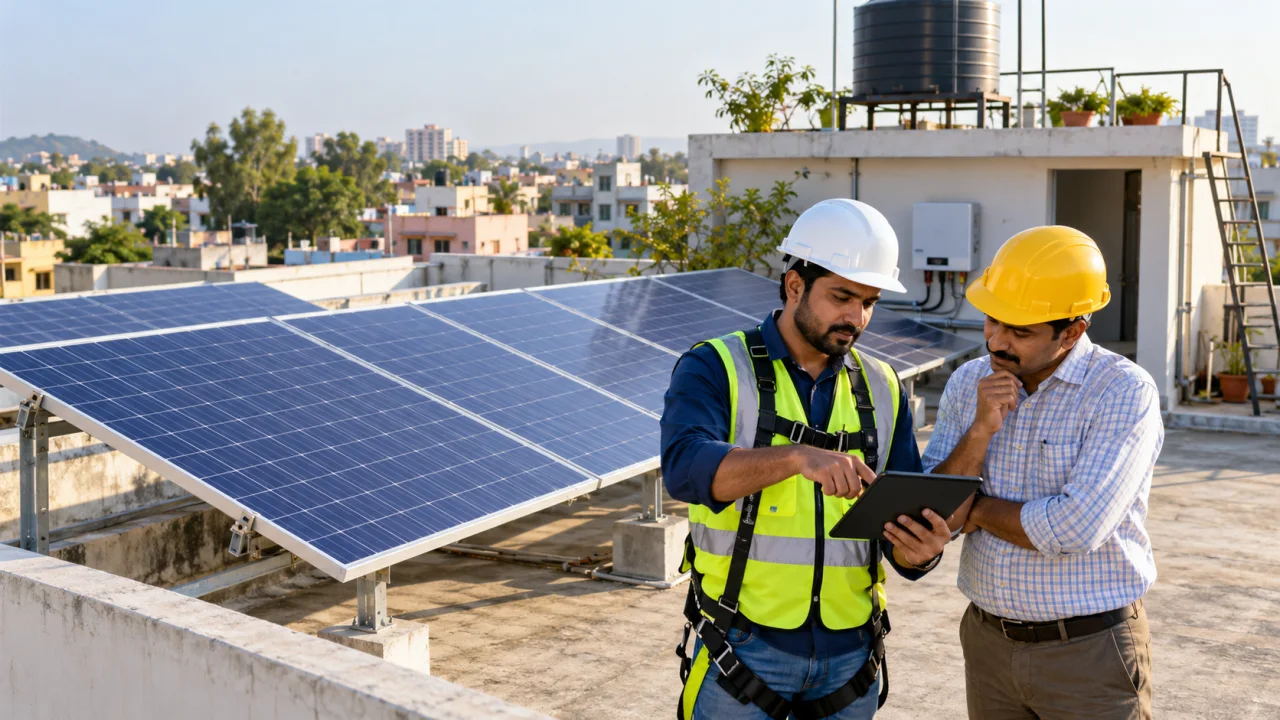
A proper survey should record sanctioned load, roof ownership, usable shadow-free area, structure condition, orientation, cable route, earthing, lightning protection, inverter location and DISCOM feasibility. Confirm the latest domestic-content and enlisted equipment requirements for subsidised work. Poor design or unsafe installation can create generation loss, leakage, electrical risk, failed inspection and expensive revisits.
A local lead funnel needs education, not subsidy promises
Build demand through verified housing societies, electricians, builders, small institutions and customer referrals. Use a bill-based qualification form, roof photos and a site-visit checklist. Explain that savings depend on consumption, system generation, tariff, shadow, financing and net-metering rules. Publish service areas and response times, then measure qualified surveys, proposals, conversions, commissioning days and referral rate.
Solar dealership pre-payment checklist
Verify the contracting company, GST and bank beneficiary; confirm whether you are only a reseller, lead partner or execution partner; and obtain territory, target, deposit, pricing, equipment, lead ownership, training, installation responsibility, warranty, insurance, payment, renewal and exit terms in writing. Check current vendor status through official routes and speak independently with operating partners. JustStartup does not allot government empanelment or guarantee solar-business returns.
Sources & further reading
- PIB: PM Surya Ghar crosses 50 lakh beneficiary households, August 2026
- PIB: India solar capacity and PM Surya Ghar factsheet, August 2026
- MNRE: PM Surya Ghar residential-consumer operational guidelines
- National Portal for Rooftop Solar: official vendor login and guidance
- National Portal for Rooftop Solar: DISCOM portal and contact links
- Mercom India: Q2 and first-half 2026 rooftop solar market update
This guide is general information, not legal, tax or investment advice. Verify every opportunity and engage qualified professionals where appropriate.